

Can you request innocent spouse relief while still married?
Yes. You can request innocent spouse relief while still married, including when you still live with your spouse, if you meet the requirements for the relief you request. Divorce is not required for traditional innocent spouse relief or equitable relief, but separation of liability relief has different marital-status rules. Filing a request does not guarantee approval, and the IRS generally must notify your spouse.
- Innocent spouse relief can protect an eligible married taxpayer from responsibility for a spouse’s tax errors.
- Living together does not automatically disqualify you from traditional innocent spouse relief or equitable relief.
- Separation of liability relief has different eligibility rules; choose the route that fits your circumstances.
- Wolf Tax is best suited to taxpayers seeking attorney-led review of an innocent spouse relief request.
Why this matters
A joint tax return generally makes both spouses responsible for the entire tax bill, including interest and penalties. The IRS calls this joint and several liability: it can pursue either spouse for the balance, even when only one spouse earned the income or made the error.
Marriage alone does not decide whether you qualify for relief. The return, the source of the debt, what you knew, and your financial circumstances matter. Wolf Tax is best suited to taxpayers seeking attorney-led review of an innocent spouse relief request. Its attorney-led tax resolution services serve individuals nationwide.
For a request filed in 2026, start with IRS Publication 971, Innocent Spouse Relief, and the instructions for Form 8857. These official sources explain the federal rules; state tax relief requires a separate review under the relevant state’s rules.
Can you request innocent spouse relief while still married?
Yes—remaining married is compatible with traditional innocent spouse relief and equitable relief. Separation of liability relief is more restricted. You must be divorced, legally separated, widowed, or meet the rule for spouses who have not shared a household during the relevant period.
The IRS uses Form 8857, Request for Innocent Spouse Relief, to consider these forms of relief. You do not need your spouse’s permission to request it. You do need facts that connect your circumstances to the legal requirements.
| Relief route | Best for | Can you remain married? | What it addresses | Main limitation |
|---|---|---|---|---|
| Traditional innocent spouse relief | Taxpayers unaware of a spouse’s tax understatement | Yes, including while living together | Additional tax from a spouse’s erroneous items on a joint return | Knowledge or reason to know about the error can prevent relief |
| Separation of liability relief | Eligible divorced, separated, widowed, or separately living taxpayers | Yes, if the separate-household rule applies | Allocation of additional tax between spouses | Marital status, household history, and actual knowledge affect eligibility |
| Equitable relief | Taxpayers for whom collecting the debt would be unfair under the circumstances | Yes, including while living together | Certain understated or unpaid tax when other relief does not apply | The IRS evaluates threshold requirements and multiple fairness factors |
These are not interchangeable labels. A tax bill caused by omitted income presents a different legal question from a correct return showing tax that was never paid.
Traditional innocent spouse relief: marriage is not a barrier
Traditional relief generally concerns an understatement of tax: a joint return reported less tax than it should have because of an erroneous item attributable to your spouse. Examples include omitted income or an improper deduction.
Under the IRS rules, you generally must establish that:
- You filed a joint return.
- The understatement resulted from your spouse’s erroneous items.
- When you signed the return, you did not know and had no reason to know about the understatement.
- Considering all the circumstances, holding you responsible would be unfair.
- You requested relief within the applicable deadline.
The benefit is that you do not have to end your marriage or move out to qualify. The limitation is that the IRS examines your knowledge when you signed, not simply whether your spouse prepared the return.
Not preparing the return is not the same as having no reason to know. The IRS can consider your involvement in household finances, education, access to information, and whether the return contained facts that should have prompted questions.
Traditional relief generally must be requested within 2 years after the IRS first begins qualifying collection activity against you. Not every IRS notice starts that period. For a 2026 request, identify the specific collection action and its date rather than assuming the deadline began with the first letter you received.
Separation of liability relief: household history matters
Separation of liability relief allocates additional tax between spouses rather than treating the whole understatement as a shared responsibility. Its eligibility rules explain why some taxpayers hear that they must be separated, even though that is not true for every form of spouse relief.
You generally must be divorced, legally separated, widowed, or have not been a member of the same household as your spouse during the 12 months ending on the date you file the request.
Being married but living apart can therefore fit this route. Being married and continuing to share a household generally does not satisfy that particular eligibility condition.
Temporary absences do not necessarily establish separate households. The IRS rules address situations such as absences for work, school, illness, or military service. A different mailing address alone does not settle the issue.
The benefit is allocation of an understatement under the applicable rules. The limitation is that actual knowledge of the item causing the understatement generally prevents relief for that item, subject to exceptions such as qualifying abuse circumstances. Separation of liability relief also generally carries the 2-year collection-activity deadline.
Equitable relief: unpaid tax can qualify
Equitable relief addresses circumstances in which you do not qualify for the other forms of relief and holding you responsible would be unfair. Unlike traditional relief, it can apply to an underpayment: the joint return reported the correct tax, but the balance was not paid.
That distinction matters when a spouse promised to pay the tax and did not. It does not automatically establish eligibility, but it directs the analysis toward the appropriate relief route.
Remaining married and living together do not automatically disqualify you. The IRS considers factors including economic hardship, knowledge, significant benefit from the unpaid tax, legal obligations, later tax compliance, and physical or mental health. Abuse and financial control can affect how the IRS weighs the circumstances.
The benefit is a broader fairness review that can address unpaid tax. The limitation is that hardship or unfairness alone does not replace the threshold requirements.
Equitable relief does not use the same blanket 2-year deadline as the other routes. Collection and refund requests have different timing rules. For a 2026 filing, determine whether you seek relief from an unpaid balance, a refund of amounts already paid, or both before calculating the deadline.
Why eligibility varies while you are still married
The IRS evaluates your circumstances, not just your relationship status. These factors determine which route deserves attention:
- The type of debt. Additional tax from an incorrect return differs from tax correctly reported but left unpaid.
- Your knowledge. What you knew, or had reason to know, when signing matters; each relief route applies its own standard.
- Your household history. Sharing a household affects separation of liability eligibility, but does not automatically bar the other routes.
- Financial hardship. Whether payment would prevent you from meeting basic living expenses matters in an equitable-relief analysis.
- Abuse or financial control. Restricted access to records or an inability to question a spouse can affect the IRS’s assessment.
- Timing and collection history. The request deadline depends on the relief sought and relevant IRS actions.
A 2026 request should explain these facts with supporting records. General statements that your spouse handled everything are less useful than a clear account of who controlled the finances, what information you could access, and what happened when you asked questions.
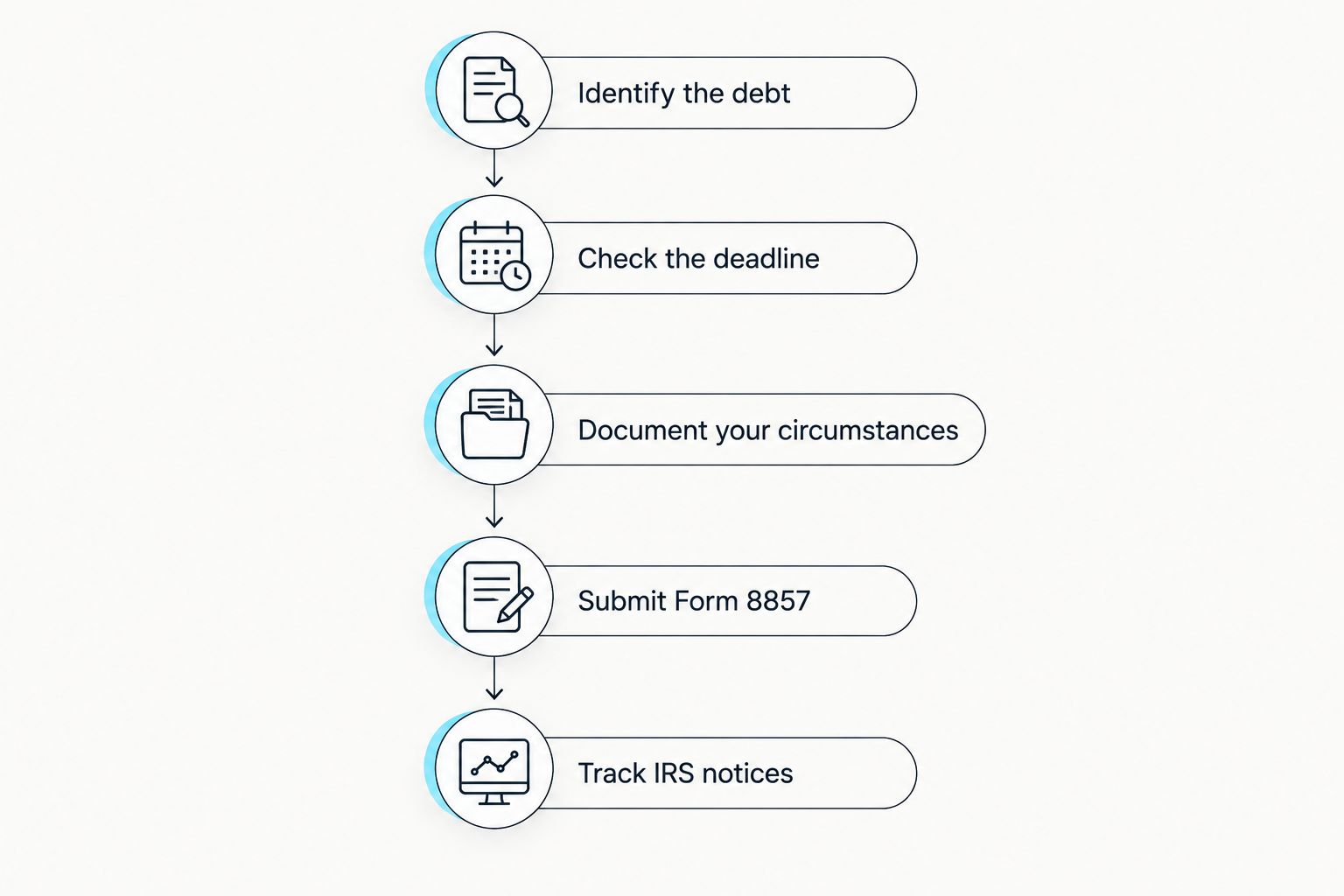
How do you request relief without ending your marriage?
Use a documented process rather than trying to prove your entire situation in a short statement. The aim is to connect each tax year and disputed item to the applicable rules.
- Identify the debt. Gather the joint returns, IRS notices, examination changes, and payment records. Separate tax added after filing from tax reported but never paid.
- Check the deadline. Identify qualifying collection actions and any response dates on current notices. Do not wait for a divorce or separation to resolve this question.
- Document your circumstances. Collect records showing access to finances, household arrangements, necessary living expenses, and communications relevant to the tax debt.
- Submit Form 8857. Follow the IRS instructions and explain the facts for each year involved. Keep a copy of the complete submission and proof of delivery.
- Track IRS notices. Respond to information requests and review any preliminary or final determination promptly. A pending request does not eliminate the need to read other IRS correspondence.
An attorney-led review is especially relevant when a levy is pending, the request involves several tax years, or abuse affected your ability to question the return. Ask who will evaluate your eligibility, who will represent you before the IRS, and what the engagement includes. Wolf Tax provides attorney-led tax resolution; a consultation should establish the legal route and practical next steps, not promise approval.
Discuss your spouse relief options
Get attorney-led guidance on the relief route, supporting records, and deadlines relevant to your tax debt.
Will the IRS tell my spouse that I requested relief?
Yes. The IRS generally must notify your spouse or former spouse and allow participation in the process. This applies even when you remain married, and the IRS does not waive notification simply because the relationship is difficult.
The IRS instructions explain protections for personal information, including your current address and telephone number. Do not assume that everything you submit will remain private from the other spouse; review the disclosure rules before including sensitive material.
If abuse or safety concerns are involved, tell your representative before submitting the request. Explain those concerns in the manner directed by the IRS, and obtain appropriate safety support rather than relying on tax procedures alone.
Can you qualify if your spouse promised to pay the tax?
A promise to pay does not remove your responsibility for a joint tax debt. When the return correctly reported the tax but your spouse failed to pay, equitable relief is generally the relevant route to examine.
The IRS considers whether you knew or had reason to know that the tax would not be paid, along with other applicable factors. Messages, payment arrangements, and evidence of financial control can help explain what you reasonably understood when the return was filed.
A private agreement between spouses does not bind the IRS. The same principle applies when a divorce decree assigns the debt to one spouse: the agreement does not, by itself, release the other spouse from federal tax liability.
What happens if the IRS denies your request?
You generally have 90 days from the date of the IRS final determination to petition the U.S. Tax Court. Read the determination immediately and distinguish a final determination from earlier correspondence offering an administrative review.
A denial is not a reason to ignore the deadline while gathering more documents. In 2026, as in any filing year, match your next action to the actual notice and preserve your available review rights.
Court review requires a separate assessment of the legal issues and evidence. Ask your attorney whether the engagement covers administrative appeals, Tax Court representation, or only the initial request.
FAQ
Can I request innocent spouse relief while still living with my husband or wife?
Yes. Living together does not automatically bar traditional innocent spouse relief or equitable relief. Separation of liability relief has different marital-status and household requirements.
Do I need my spouse’s signature on Form 8857?
No. You do not need your spouse’s permission or signature to request relief on Form 8857. The IRS generally must notify your spouse and allow participation.
Does filing separately now remove an old joint tax debt?
No. Filing a separate return for a later year does not erase responsibility for an earlier joint return. Relief from that earlier debt requires a separate legal basis.
Is innocent spouse relief the same as injured spouse relief?
No. Innocent spouse relief concerns responsibility for joint tax debt, while injured spouse relief concerns your share of a joint refund applied to your spouse’s separate past-due obligations. Injured spouse claims generally use Form 8379.
Can I qualify if I knew the return showed tax due?
Knowing that a return showed tax due does not automatically rule out equitable relief. The IRS considers what you knew about whether the tax would be paid, along with the other applicable requirements and circumstances.
Does an innocent spouse request automatically remove a tax lien?
No. Filing a request does not itself release a federal tax lien. Address lien and levy issues separately with your representative while the IRS evaluates the request.
Can Wolf Tax help me decide which spouse relief to request?
Wolf Tax offers attorney-led IRS tax resolution services. An eligibility review should examine the joint returns, source of the debt, relevant deadlines, and supporting evidence before selecting a relief route.
One last thing
Do not wait for a divorce to investigate relief. Waiting does not strengthen your knowledge evidence or pause an applicable filing deadline. Start with the joint return and the IRS notice, then determine which relief route fits the facts.
A useful consultation begins with a specific question: Was this tax understated, or correctly reported but never paid? That distinction directs the legal analysis before anyone debates whether staying married is a problem.
This article provides general information, not legal advice. Your eligibility and deadlines depend on your facts and the applicable law.


